



By Sue Crowley, Executive Director
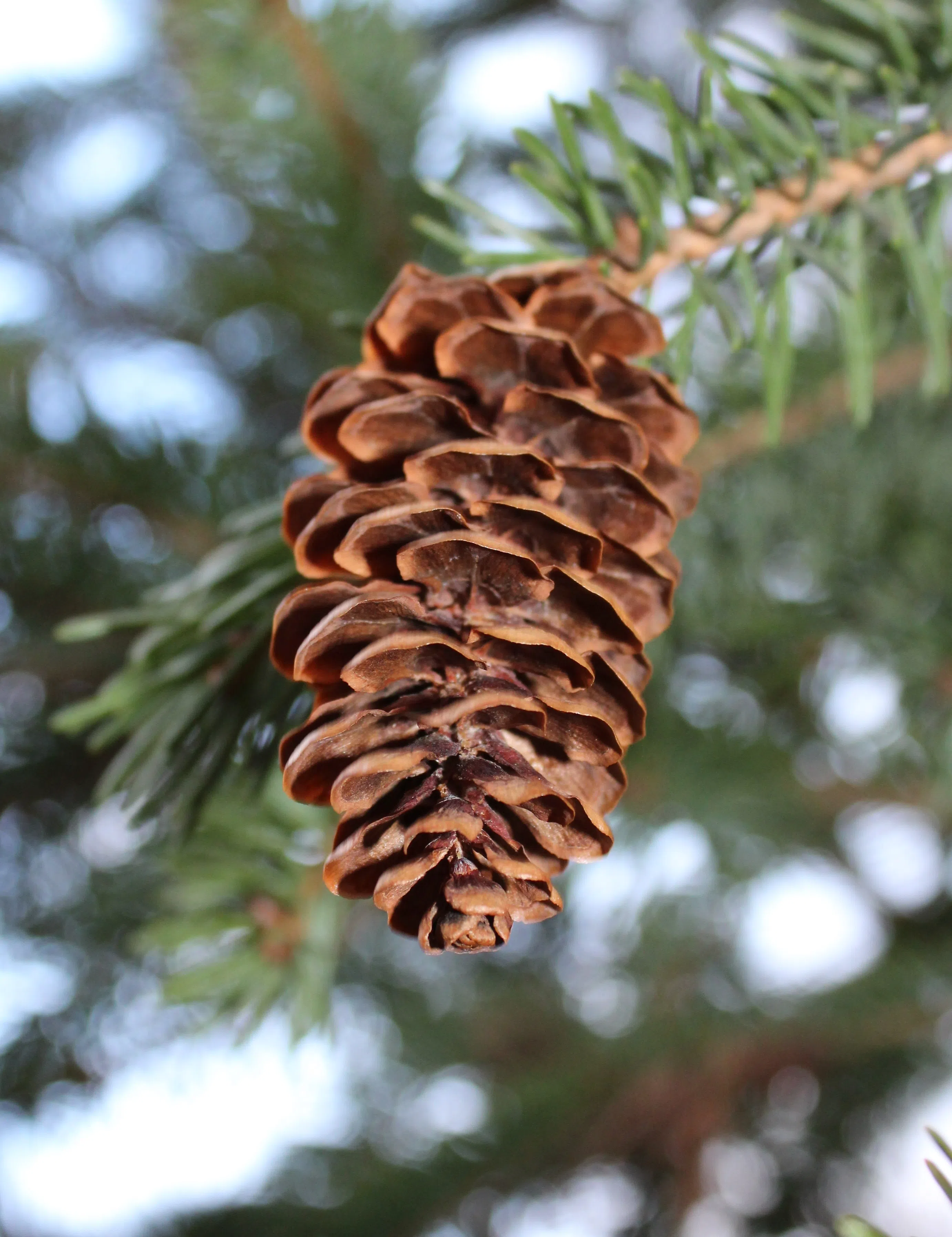
Our photo hub group at Woodland Dunes was out and about capturing some plants and wildlife the other evening when I came upon a lovely white spruce with a low hanging cone. Now we all like to call these cones, pine cones, yet truth be told the proper name is technically a spruce cone. However, if one considers that although the genus of spruce is Picea, the broader family to which spruce belongs is Pinaceae. So, perhaps calling all cones pine cones is quite accurate after all!
The female cones (see photo) of white spruce are usually about 1 to 2½ inches long and the seed which develops under each the bracts is about an 1/8 inch in diameter. The male cones which have all the pollen are smaller. The male pollen cones are on the ends of branches are less rigid and scruffy in appearance. The wind blows them and distributes the pollen to the female cones so that seed within will be fertilized. Did you know when both male and female cones are on the same tree the species is called monoecious, where “mono” means one and “ecious” means house. As opposed to plant species that have a female plant and a separate male plant, these species are dioecious or two houses.
The female cones are quite amazing in that they are designed to protect the seeds until they are mature enough to drop or blow in the wind and then finally find a landing spot to germinate in the soil. One function of the cones is that when conditions become unfavorable for the seed the bracts of the cone close tightly. For example, during a rain event they will close and then reopen again once the rain has ceased. You can see this phenomenon for yourself if you pick an open cone and then place it in a cup of water. Let it soak for five to ten minutes and then check it. You will see the bracts have closed. Leave the same cone out to dry and it will reopen. Nature is simply amazing!
Of course, the seeds in these cones also provide a source of food for birds such as chickadees, juncos, nuthatches, and sparrows. Squirrels and chipmunks are happy to eat these tasty morsels as well. Let’s not forget about some insects that also find the seeds valuable such as the spruce seed moth and spruce seed midge. So, the next time you see a ‘pine” cone, think about how valuable it is for the seed within and those other critters that may like it too.