



The following article is written by Carrie Estrella for the Art Forward series through the Rahr-West Art Museum.
Yesterday (February 1st, 2022) marked the new year according to the Chinese zodiac, a calendar that follows a 12-year cycle, each year being associated with a specific animal and that animal’s respective characteristics. A Chinese folktale suggests that the cyclical order of animals was determined by a ‘Great Race’ organized by the Jade Emperor (ruler of heaven according to Chinese mythology.) The order of the animals in the cycle reflects the order in which they finished the race, which according to the legend was (1st place to 12th place) Rat, Ox, Tiger, Rabbit, Dragon, Snake, Horse, Goat, Monkey, Rooster, Dog, and Pig. This means that, as the ‘Year of the Tiger’, we find ourselves in the third year of the twelve-year cycle.
The Chinese Zodiac Calendar, being a lunisolar calendar, integrates both the revolution of the Earth around the Sun as well as the movement of the Moon around the Earth. The new year celebration on this calendar is connected to the second new moon of the year, which typically lands sometime between late January and mid-February, this year on February 1st!
But, how does the Chinese zodiac connect to art within the Rahr West Art Museum’s collection?
Since 1993, Manitowoc has been paired with the small seaside city of Kamogawa, Japan in a Sister City Relationship. Over the years, the connection between the two cities has resulted in many exchanges – of people, gifts, culture, and artwork.
While the zodiac’s origins are Chinese, the concept (or variations of it) have influenced cultures throughout Asia since its creation; this includes Japan. The Japanese version of the zodiac has been adapted slightly from the Chinese original – in place of a goat, a sheep is used and in a place of a pig, a wild boar is used – but the rest of the animals match the Chinese zodiac.
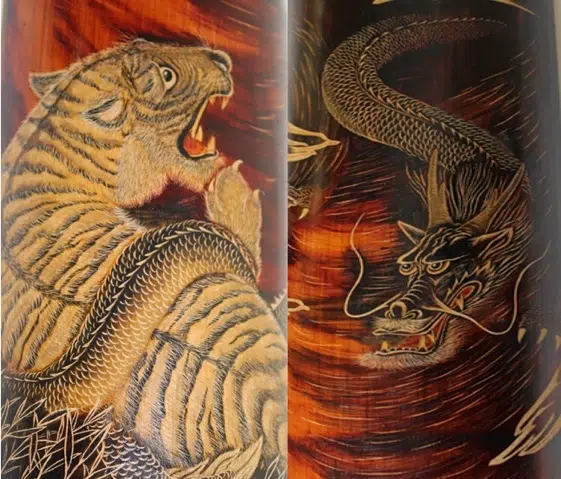
As 2022 is the Year of the Tiger, we searched our collection at the Rahr West Art Museum and discovered that some of the items on loan to the city of Manitowoc from Kamogawa have been adorned with tigers. Tigers, not native to Japan, are often found in Japanese artwork because of the influence the Chinese zodiac has had on Japanese culture. Zodiac animals, in general, are believed to promote good luck, good harvests, and prosperity – but both the dragon and the tiger are considered to be especially mighty and auspicious in Japanese folklore.
According to the National Gallery of Art in Washington, D.C. – an old Chinese proverb states “Dragons bring the clouds, tigers call forth the wind.” In this way, the flying dragon and prowling tiger came to represent heaven and earth, governors of the elemental forces of wind and rain and were revered as rulers of the cosmos and the natural world. The symbolic pairing of these two zodiac animals was believed to bring about the blessings of rain and peace and to illustrate the ancient Chinese concept of yin and yang, being complementary opposites of each other.
Astrologers believe that moving into the Year of the Tiger (from 2021’s Year of the Ox) will bring us all higher levels of energy. Tiger years are thought to evoke self-confidence, competence, courage, and vitality – and the zodiac foretells a particularly lucky year in 2022 of strength-building and restoration.
I’m thankful that our friends in Kamogawa have shared these pieces of art with us so that Manitowoc has its own tiger guardians watching over us in 2022!
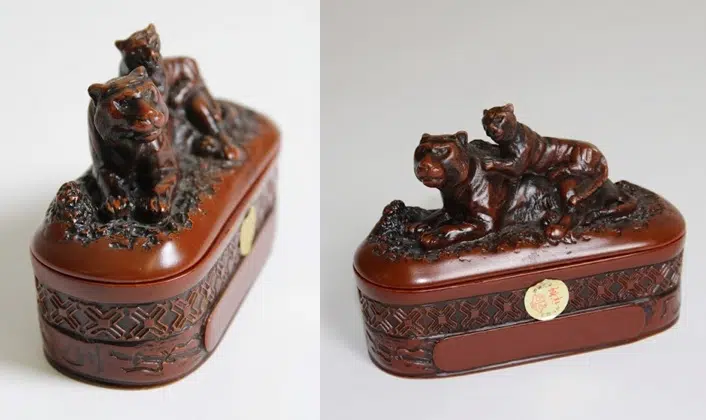
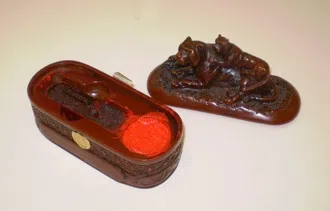
Letter stamp in case with two tigers, Japanese, L-2010.7 City (Rahr-West Art Museum)
The color of red is considered particularly auspicious according to Chinese traditions; it symbolizes good fortune, luck and prosperity. It is the primary color used in New Year celebrations.

Dragon and Tiger Ukishoebori, Moso bamboo, Aiko Sunada, Japanese, L-2006 City 1 (Rahr-West Art Museum)
Mr. Keishu Kobayashu developed a new type of bamboo art using Mosobamboo (native to the southern Chiba region of Japan) by chiseling and dying. At the time this piece of art was donated to the City of Manitowoc, Mr. Kobayashi was teaching his craft to over 300 students in the Chiba area.