




The following article was written by Carrie Estrella for the Rahr West Art Forward series.
January 27th marks the anniversary of the liberation of the Nazi Concentration and Extermination Camp of Auschwitz-Birkenau by Soviet troops in 1945. In November 2005 UNESCO (the United Nations’ Educational, Scientific, & Cultural Organization) chose to recognize January 27th as Holocaust Remembrance Day – a day dedicated to the memory of the victims of the Holocaust. This day also reaffirms the larger commitment of the United Nations to counter antisemitism, racism, and other forms of intolerance that may lead to group-targeted violence in the world today.
It goes without saying that the Holocaust profoundly affected countries in which Nazi crimes were committed, but these atrocities also had universal implications throughout the world, including the world of art. As tomorrow is officially Holocaust Remembrance Day, it felt appropriate to highlight some of the artists and their artwork to our readership.

Autoportret, Franciszek Jaźwiecki from Auschwitz-Birkenau State Museum art collection

Dividing Families, unknown artist from Auschwitz-Birkenau State Museum art collection
Not all artwork produced in concentration camps were purely documentary in nature. Some of the artwork producedillustrate an attempt to make the best of their situation and also to convey a sense of hope as well. In Gurs camp, in southern France near the Pyrenees mountains, Kurt Conrad Löw and Karl Robert Bodek often collaborated on artwork for camp events and posters. In the same camp lived a woman, Hanna Schramm, a German school teacher who was removed from her post due to her political affiliations and was later accused of being a spy. After being liberated, Schramm published a number of books, including Vivre à Gurs (which is available on Amazon.com) in which she shared what life was like in the camp. Although not a professional artist, she illustrated her book with her own humorous and ironic drawings.

Karl Bodek and Kurt Conrad Löw, One Spring (1941), produced in the Gurs Camp in southern France from the collection of Jerusalem’s Yad Vashem Museum

A caricature drawing by Kurt Conrad Löw in the Gurs camp in southern France (1942) from the Ghetto Fighters House Archives. The central figure of this image is believed to be Hanna Schramm.
The Theresienstadt (Terezín in Czech) ghetto was promoted to be an artistic colony by the Nazis – it essentially gave the regime a special location to send many globally reknownJewish artists that would be noticed should they suddenly go missing. But despite some special allowances for the artists and their families in this camp – for example, art class – life at Theresienstadt was far from happy. In fact, of the 15,000 children transported to Theresienstadt, only 100 survived the war. Over 4,000 drawings were collected by the art teacher and smuggled out of the concentration camp; they have been part of the Jewish Museum of Prague’s art collection since the end of the war. Pavel Fantl, a doctor from Prague, was also able to paint secretly in the Theresienstadt ghetto, producing this piece of resistance illustrating Hitler as a clown. Fantl and his family, along with so many other prisoners, were eventually deported to Auschwitz where they died in January 1945. A Czech worker hid his artwork in a wall.

Pavel Fantl, The Song is Over (1941-1944) created in Terezín ghetto from the collection of Jerusalem’s Yad Vashem Museum
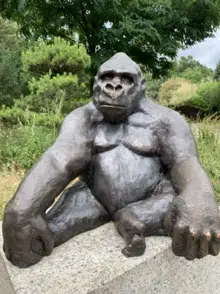
Sculpture in the Warsaw Zoo, Magdalena Gross (submitted by author)
The scars of the Holocaust ran deep and continued to influence art over the decades following liberation. Max Bueno de Mesquita was a young artist just at the beginning of his career at the time when the Nazis invaded the Netherlands. Immediately he and his family went into hiding. They stayed successfully hidden for just over a year of time, but eventually were discovered and sent to the concentration camps where most of his family met their end. After the war, Bueno de Mesquita tried to face his past through his artwork, documenting the atrocities he had witnessed. Medically he was treated for “Post Concentration Camp Syndrome” with LSD. During his treatment, Bueno de Mesquita created a number of works of art using bright gaudy colors to depict the indescribable nightmarish memories in his mind.

Max Bueno de Mesquita, Mother in the Gas Chamber with Butterfly from the collection of Beit Lohamei Haghetaot, Museum Number 1643
These artists are only a few of the many lost to the world during World War II. I would like to leave you with the astute words of Anne Frank – “What is done cannot be undone, but one can prevent it happening again.”