



The following article was written by Diana Bolander, Assistant Director/Curator at the Rahr-West Art Museum.
Patrick Burke and Randy Sahli, two of the makers featured in the Manitowoc Cabinet exhibit are somewhat hesitant to refer to themselves as artists and prefer the term artisan. The word artisan is often overused in consumer culture, but to be frank, Burke and Sahli are expert craftspeople. Historically the line is blurry between art and craft and they both are more interested in function than aesthetics, though one might not make that distinction looking at their creations. Burke and Sahli earned their expertise through hard, dedicated work in apprentice programs rather than taking the university path. Their education focused on the application of skill and precision, as well as intense research on aesthetics, art history, and contemporary trends.
Patrick Burke grew up in Manitowoc. He started an apprenticeship with his father, a carpenter, when he was still in elementary school. His father would give him a picture or an object to recreate and Patrick would figure out how to do it. Patrick learned early that he loved creating things with his hands and quickly became quite skilled. After a stint where he focused on BMX biking, which resulted in an unfortunate injury, Burke decided to become a full-time professional artisan. In 2007 and 2008, Burke apprenticed in Florence and Ortisei, Italy, an area with a 300-year-old tradition in the art of woodcarving. He also took part in numerous workshops throughout the U.S. and was hired to work overseas on various high-end projects in Canada, Germany, the Netherlands, France and the U.K.
Burke believes he is influenced by a myriad of styles, especially portraits and figurative work. He describes his work as observational, whether he is working directly from a human figure in his figurative sculpture or observing historic examples of ornaments for commissions.
His bread-and-butter is the ornamental work he completes for architects around the world, yet he has also worked with museum conservators, churches, and on private commissions. He is self-employed and in a niche market, thus his work relies heavily on referrals and being tied into a network of specialists in classical architecture. Burke has worked in more than wood, perhaps most notably in his work with Ray Villafane, an artist based in Arizona who is famous for intricate pumpkin carvings.
Some projects take him years to complete, like the ornamental and architectural details Burke created for the 60,000 square foot Le Palais Royal estate based on the Palace at Versailles in Hillsboro Beach, Florida. In addition, for the 150th celebration of Canada’s confederation, he worked with artists Alexandre Lipensky and Andrei Marek to create two Senate Thrones for the Parliament of Canada dedicated to Queen Elizabeth II. Indeed, the English walnut used in the project was harvested from the Queen’s forest.
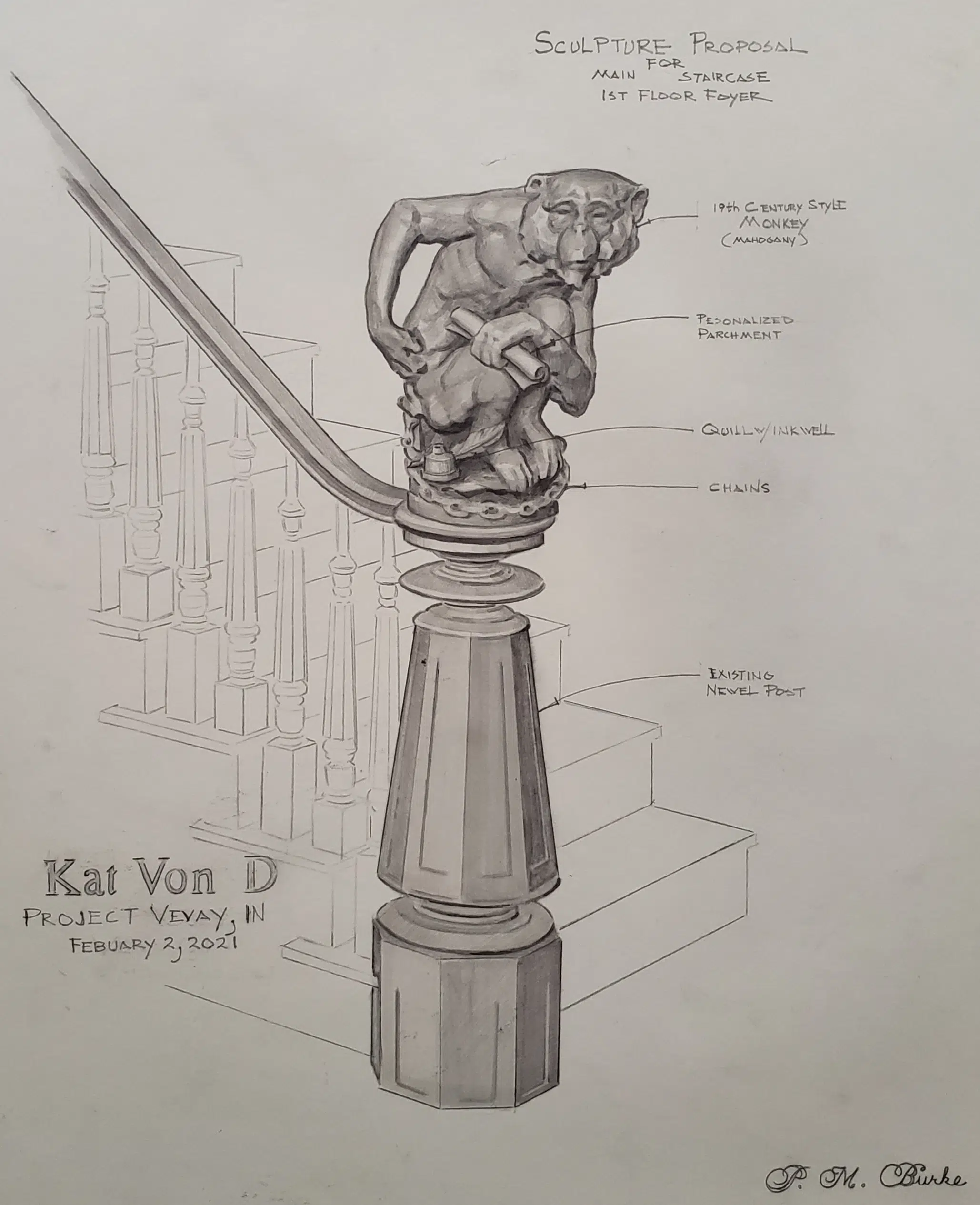
Burke is currently working on Louis XVI style carvings for the owners of the Blistex Company, a bronze sculpture for a chapel in Chicago, and wood carvings and ornaments for a house that the famous tattoo artist Kat Von D is renovating. A monkey sculpture featured in the exhibit will be featured in the house on the grand staircase. His journey in the art world up to now has been quite amazing and it all started here in Manitowoc!

Adam and Eve by Randy Sahli and Julie Gunderson, on loan from the collection of the Museum of Wisconsin Art
Randy Sahli loves wood and working with his hands. Capturing the beauty naturally present in nature is key to his work. “I attempt to showcase Nature’s abundant artistry in my work using Best & Select grade, highly figured local hardwoods,” Sahli states. A salvager of sorts, Sahli saws all his own lumber from local wind-downed and dead trees. He saws the tree burls and crotches them into matched veneers.
He greatly enjoyed Industrial Arts when attending Menasha High School and one summer worked for the Neenah Foundry. He knew instantly that he wanted a “more individually expressive form of employment.” Sahli apprenticed with a master carpenter and started his own business, Buttes des Morts Joinery in Menasha in the early 1970s. In 1974, the Appleton Post Crescent View wrote an article about the steam-bending in his show. He later moved to Colorado and made high-end, custom furniture for investment bankers and skiers. However, when drought parched the Rocky Mountain region he returned to Wisconsin and now his home and studio overlook a river and a bird-filled, wildflower meadow in Waupaca County.
The last forty years, Randy Sahli has partnered with his wife Julie Gunderson, who does the finishing of the works. He describes her as “the best finisher there is.” Randy mills the parts and does the joinery. Julie sands and finishes the pieces. Sahli reports that it takes about the same amount of the time to do both parts of the job. “We make a perfect team,” he says.
The Manitowoc Cabinet, along with a selection of the work of Randy Sahli, Patrick Burke, and David Carpenter, can be seen at the Rahr-West Museum through September 5, 2021. We are truly honored to share the work of such talented artisans that are part of our state.