


Article written by Amy Meyer, Executive Director – Manitowoc County Historical Society.
Signs of the past are all around us. Whether driving down a highway or strolling city streets, traces of old advertising murals can be seen on buildings and barns. These hand-painted signs tell of a seemingly simpler time – where the highlight of things to sell were the latest fabrics or tickets to the traveling circus. All you needed was an open wall—any open wall. A farmer’s barn, grain silos, warehouses, and city buildings became canvases. In larger cities and communities, the painters of the advertising signs were called “wall dogs” because they often had to scale or climb a structure to complete the sign.
Painting of advertising on structures became popular following the American Civil War. Towns and villages were eager to promote their amenities and draw travelers to their boarding houses, saloons, and attractions.
The General Store was a main attraction for many rural communities and a common building for artists to display their signage. General stores were the center of economic activity in many small towns in the late 1890s and early 1900s – a place where seed and crops were bartered or sold and everything people were not able to make or raise at home or on the farm could be found. The general store was the place to purchase a bar of soap, nails and hardware, thread or broad cloth for making clothes for the family, hats and hat pins, candies, toys and other treasures. Storekeepers were leading citizens of their communities. They extended and denied credit for food, supplies, and other goods against farmers’ next crop. No rural community could hope to become a village without a general store.
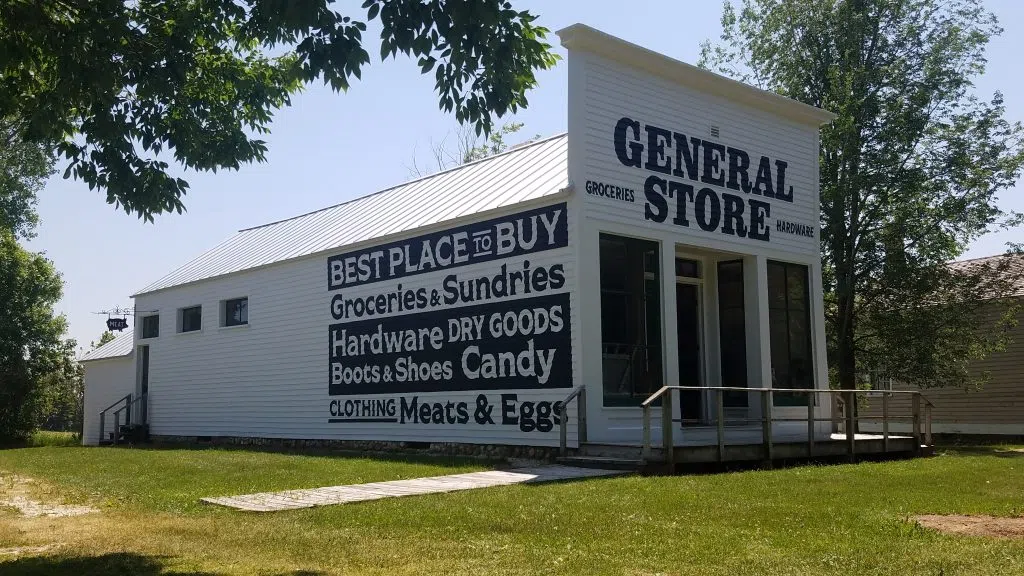
Pinecrest General Store advertising mural complete
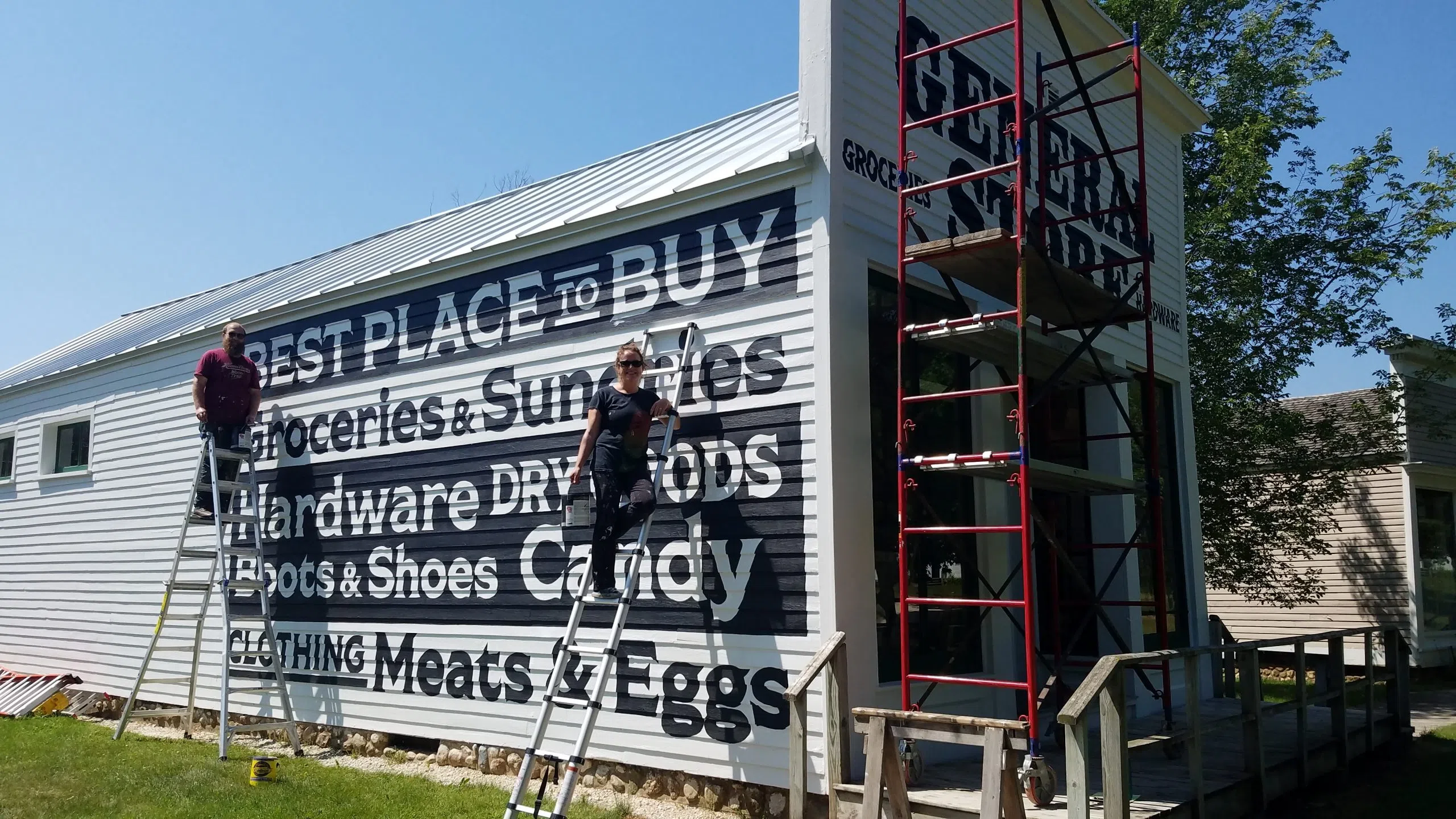
Our Manitowoc County Historical Society recently added a hand-painted advertising mural to 1870s General Store at Pinecrest Village, announcing it as the “Best Place to Buy – Groceries & Sundries; Hardware, Dry Goods, Boots & Shoes, Candy, Clothing, Meats & Eggs.”
The advertising mural was designed by David Carpenter and hand-painted by Carpenter and Erin LaBonte. The font of the mural was inspired by fonts of the era and the overall advertising billboard pays tribute to signage that was located on the Cato General Store at the turn of the 20th century. Although the Cato store was razed, pieces of it remain inside our museum’s General Store.
The Pinecrest General Store, built in the 1870s, was originally located in the village of Clarks Mills, just four miles west of its current location as part of Pinecrest Village.
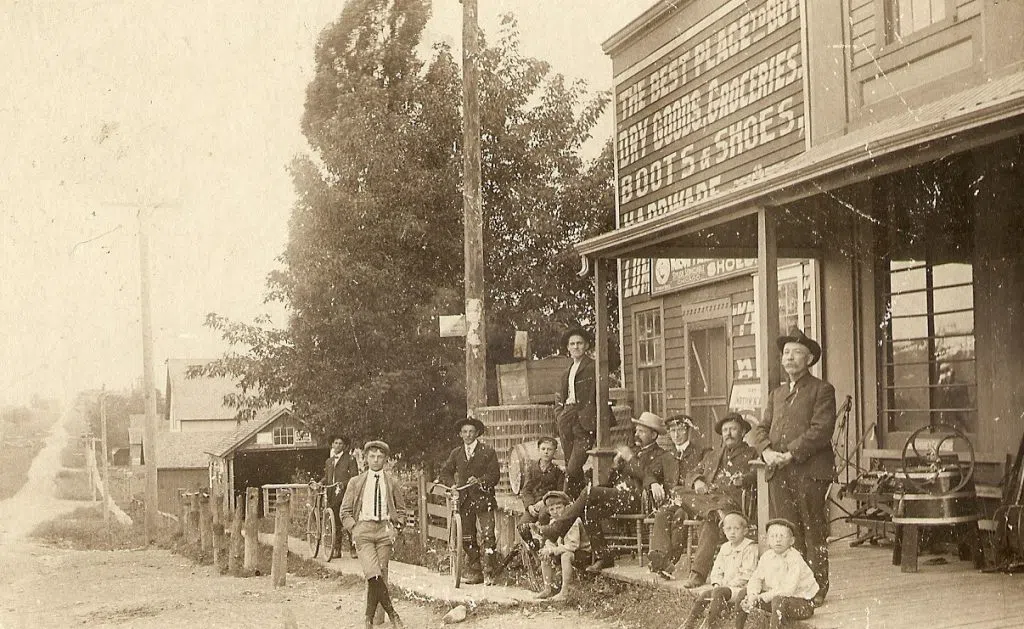
Inspiration for the project from a photo of the Cato General Store, circa 1900.
Richard Burke purchased the store lot from Ella Beach in 1884. The Burke family operated the site for about 10 years before moving to the city of Manitowoc, on the corner of 8th and Huron Street. Burke became a lawyer at the law firm of Schmitz, Burke and Craite for many years and also served as city attorney under the administration of Mayor Henry Stolze.
The General Store was operated by Michael and Catherina Pritzl around the year 1907 and by William and Rose Klann from 1910 to 1926. The building was purchased by Harold Morgan in 1926, who operated it as “Morgan’s Store” until his death in 1961. The building was sold again in 1977 to Dennis Jagodzinsky who operated it as DJ’s Appliance Sales and Service until 1983.
On March 15, 1988 the General Store made its way to Pinecrest Historical Village and its story is shared with thousands of guests each year. The former Clarks Mills General Store continues to be a meeting place where news is exchanged, mail is sent and received, gossip and tall tales flow around the pot-bellied stove, and checkers and cards are played.
Many hand-painted advertising murals have faded into history but the new art added to the museum’s general store pays tribute to the craft. It not only tells the products of the day, but the advertising mural speaks to a simpler time before advertising formats changed to be more manufactured and less durable signs appeared in the later 20th century. Many ghost signs are still visible around our community if you take a closer look. The hand-painted advertising mural on our museum’s General Store brings back the nostalgia of a bygone era and connects history and art to the world around us.