



The following article was written by Max Kornetzke, the Land Manager at the Woodland Dunes Nature Center.
Wisconsin is home to many different species of ferns. Some of these ferns prefer the deep shade and moist soil of mature woodlands or mossy rock outcroppings, while others will even grow in dry, sunny conditions.
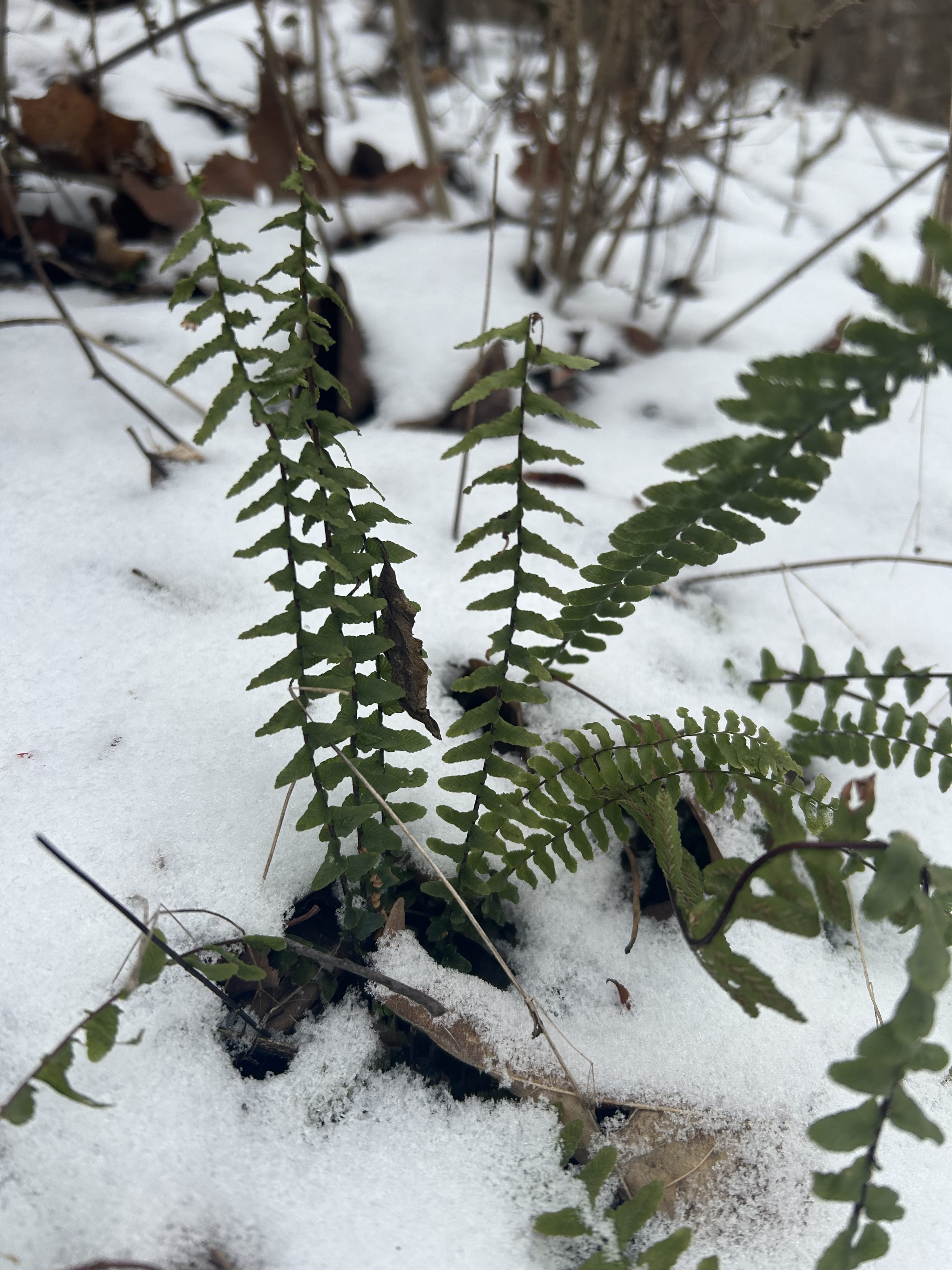
Certain species are considered rare, with some being listed as threatened or endangered in Wisconsin. Most ferns are deciduous and go dormant in winter; however, there are several species that are evergreen and can be enjoyed year round.
These evergreen ferns can be found throughout the state. Most are members of four genera: Asplenium, Pellaea, Polypodium and Polystichum.
Ferns in the genus Asplenium are commonly referred to as “Spleenworts”. Their name is derived from an old idea that certain species were useful for ailments of the spleen. Most of Wisconsin’s spleenworts are lithophytes, which means they grow on rocks. The most common spleenwort a nature enjoyer might encounter is the walking fern (A. rhizophyllum).
Walking ferns are found on the cool, shaded sides of mossy boulders and cliffs. They don’t look like most ferns people are used to, which generally have divided fronds. Walking ferns have simple leaves that taper to a long point. These points will also root themselves in the moss and produce new plants, like they were walking across the surface.
Ferns in the genus Pellaea are commonly referred to as “cliffbrakes”. Their common name comes from their cliff dwelling habit and the Middle English word for fern, “brake”. There are only two species documented in Wisconsin: Smooth cliffbrake (P. glabella) and purple-stem cliffbrake (P. atropurpurea).
Smooth cliffbreaks are found throughout the state in the cracks of weathered limestone cliffs. Though they prefer limestone, they can also be found growing on sandstone or basalt. These ferns are relatively small, with fronds generally no longer than a foot. Their fronds also have a distinct leathery texture and blue-green color.
Ferns in the genus Polypodium are commonly referred to as “polypodies”. There is only one species documented in Wisconsin, called rock polypody (P. virginianum). As the name implies, these ferns like to grow in rocky soils. Their fronds are a medium green, deeply loped and usually under a foot in length. Under ideal conditions this fern can create dense colonies.
Ferns in the genus Polystichum are commonly referred to as “holly ferns”. There are three species found in Wisconsin and all of them are considered rare.
The species with the largest distribution in Wisconsin is called Christmas fern (P. acrostichoides). Christmas fern has distinct long, dark green fronds that are pinnately divided. Unlike most of the other evergreen ferns which grow directly on rocks, this species is terrestrial and grows in well drained soils under the dense shade of mature, mesic woodlands. This species is more common farther east in the United States, and can even be found sold as an ornamental at some native plant nurseries. If you’re looking for a unique, evergreen groundcover to place in a dark part of your landscape with consistent moisture, this beautiful plant might be worth looking into.


