



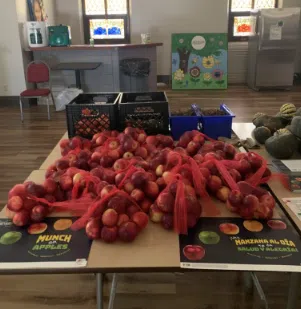
The UW-Extension of Manitowoc, Kewaunee, and Door County found a way to give unused fruits to those in need.
FoodWIse Coordinator Laura Apfelbeck was working on a project through City America’s Food Leaders Lab to find a local need and address it, which is when she learned that food pantries find it hard to find fresh food that’s affordable.
Apfelbeck then learned of the Door County Peninsula Agricultural Research Station, or PARS, which grows a lot of apples for research.
But not all of them can be used.
“Often what was happening is that the trees were simply being stripped and the apples were collected and sold for deer bait,” she explained. “There was nothing wrong with the apples, they just didn’t have the capacity to market and sell them.”
After reaching an agreement with PARS, Apfelbeck reached out to food pantries that needed it.
This would turn into the Big Apple Project, which delivers the locally grown apples to 12 food pantries, three school districts, and five nonprofits in Manitowoc, Brown, Kewaunee, and Door Counties.
An estimated 14,000 pounds of apples were distributed, but Apfelbeck admits it took some time to get the apples from Sturgeon Bay to their different places since they needed to bring a moving-type truck to haul the fruit.
Thankfully, some money came in.
“The West Foundation out of Manitowoc provided us with those startup funds, and that allowed us to purchase the necessary equipment and run a pilot,” she described. It asked questions like ‘Could we do this? Could we come up with the logistics? Could we get enough partners involved? Could we make it sustainable in some way?’”
The refrigerated trucks came from Sullivan Farms and Manitowoc’s Grow It Forward. Food was not only sold to pantries at $6 a bushel, or about 40 pounds of apples, but to school districts around the area, including the Manitowoc Public School District.
Apfelbeck says FoodWIse is now trying to form relationships with potato growers to try and bring the spuds to food pantries and to groups who need help.
More information about the project can be found online at health.extension.wisc.edu.