


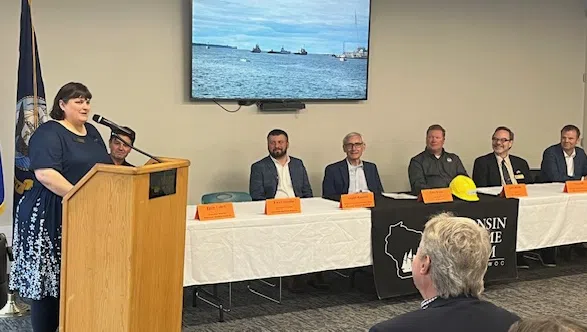
The Wisconsin Maritime Museum held a celebration after successfully dry docking the historic USS Cobia.
Museum staff, as well as city and state leaders, met at the museum on Thursday (November 20th) to thank everyone, including financial donors, submarine veterans, and others who made the dry docking of Cobia possible.
There were several speakers, including Wisconsin’s governor, who talked about the project.
Executive Director Kevin Cullen spoke first and said he couldn’t be prouder of the creative and tireless efforts of everyone, and thanked those who gave money for getting the historic WWII submarine out of the water.
“Museums are vital resources to our communities,” he stated. “And that care for the artifacts and the objects and the images and documents that are witness to unique chapters to our human journey. The Wisconsin Maritime Museum and USS Cobia remains a gathering place where we can reflect on those shared histories and the significant moments in those histories that unite us across generations.”
Submarine Curator Karen Duvalle was one of the main people in charge of making the dry docking happen.
The project was done for the Cobia veterans she’s gotten to know over the more than 24 years she’s worked at the museum, saying she didn’t want to let them down.
“I saw how much this boat meant to them and how they wanted their story to live on,” she exclaimed. “And not just the Cobia family, but several other veterans and families have found connections here. I have been fortunate enough to witness some of those moments.”
The biggest fix needed was a large crack in a portion of the keel of the sub, which wasn’t seen previously because the bottom was covered in zebra and quagga muscles.
Now that the process is over, she told Seehafernews.com that she feels relieved that the biggest need of the submarine is done, but improvements on Cobia never end.
“We can work on some of the smaller things, interpretive aspects inside, you know, like props and stories and things like that,” she noted. “And just maintaining. We still have work to do. There’s still deck pieces that need replacing and a new HVAC system on board.”
Submarine and Cobia Committee Chairman Logan Rooney told the crowd gathered that he has many stories from tours to helping people stay over on Cobia overnight.
But helping her get drydocked was what he called one of the greatest honors he’s ever had. Manitowoc Mayor Justin Nickels explained that the submarine is as important to the community now as it was when it was first brought into the city in 1970.
And donating to the drydock was something that had to be done.
“So when we were asked to stand up, we did it without hesitation,” he said. “Because it’s more than just a museum piece, if you think of it like that. It’s a living testament to Manitowoc’s history. The hard work of what we did to build submarines like this. The men and women from Manitowoc who served on submarines like this.”
State Representative Paul Tittl was one of two people who made sure some money from Wisconsin’s 2025-2027 state budget to go toward pulling the sub out of the water for hull repairs.
He called supporting the project the easiest decision he’s probably made in his political career.
The other person was Wisconsin Senate Majority Leader Devin LeMahieu.
Last to speak during the celebration was Governor Tony Evers, who called the museum a unique place and said it, along with Cobia, is something the state is proud of.
“We’re also committed to ensuring future generations can experience the traditions of visiting the Cobia that Wisconsinites and visitors across our state have done for decades,” he explained. “Also Wisconsin’s maritime history and a legacy of shipbuilding are core to who we are as a state.”
The museum raised over $1.5 million for the drydocking process, including a $500,000 grant from the National Parks Service.
Tours on the Cobia are available again as well.