



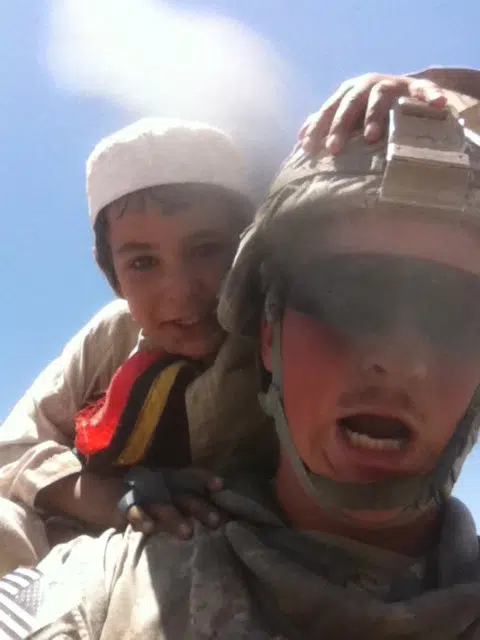
Today we continue our look into Afghan interpreters and others who have aided Allied forces in Afghanistan.
I, Ryan Brahm, spoke with an interpreter who served with me while I did a tour of duty supporting Operation Enduring Freedom in 2010 and 2011.
I was a member of the 428th Engineer Company out of Wausau during that time, and we were conducting route clearance in the Helman Province, which is in the southern portion of the country. Part of our job was to train the Afghan National Army in Route Clearance, which is driving down the road and searching for improvised explosive devices left by the Taliban.
Attached to our unit aiding us in that role was a young man named Abadul Jamail, who served as an interpreter.
I reached out to Jamail recently and asked him if he would talk to me about his unique experience. He agreed but asked that I not use any pictures of him, as he still has family in Afghanistan, who could be targeted if they happened to see this story.
I asked Jamail why he wanted to help the allied forces in such a direct way. He explained that he saw that we were “fighting for the freedom of my country, and everybody else. Because of all the positive things I was seeing in them, in the U.S. and NATO forces, that was the only reason that I started working for them, especially for the freedom of everybody.”
So, Jamail started learning the English language, and after becoming fluent, applied for a job as an interpreter in 2011.
Jamail told me he spent a total of 7 years working as an interpreter and we were his first duty station. But, “then I applied with the OCCR, NRC South, which was the central command center in 2012.”
Jamail said his family also aided the allied forces, joining the Afghan Army and Police. Even though Jamail and his family believed in the work they were doing, there were some consequences to working directly with the allied forces.
“My family had to move from the area we were living before, in the village,” he explained. “We came to the city for safety and we were finding a little bit of peace because the people didn’t know where we lived. We continued working, me and my family members.”
He was eventually able to make his way to the United States, but it wasn’t an easy process. Jamail told me he applied and waited for nearly a year before he got some assistance from someone with some pull.
“One of my best friends, the Captain I was working for in 2012, in the Engineering Company, he really helped me out to come here,” Jamail said. “He was like a brother to me. He was everything.”
Jamail is now 30 years old and has been living in Texas for the past seven years. He told me that after several months of transitioning to the new lifestyle, he was treated just like every other citizen. He said the culture is different but “the people are the same beautiful people I was seeing back in my country.”
He is now working a full-time job as a cultural advisor.
While Jamail’s story is heartwarming, he got extremely lucky. There are many others who are working just as hard as him that will never set foot outside of Afghanistan.
Tomorrow we will hear from Jamail again, as he told me more about what it is like to be a citizen in a part of the world that is overtaken by terrorists.