



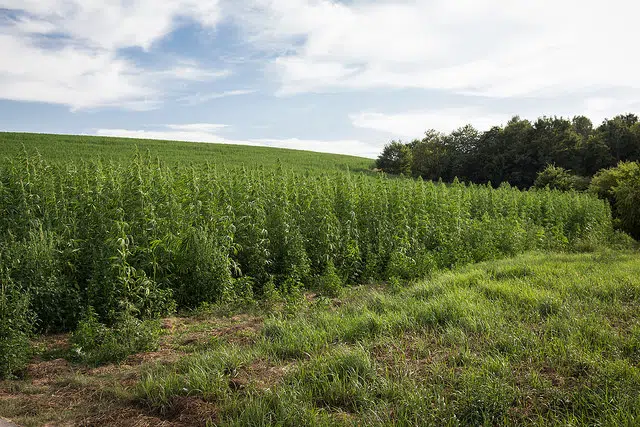
President Donald Trump has signed the Farm Bill today, setting the hemp industry up for a major breakthrough in 2019. Hemp will no longer be classified as a Schedule I controlled substance, opening up possibilities for farmers in Wisconsin and other states. Badger State lawmakers allowed farmers to research hemp production at the beginning of 2018. According to the U-S Department of Agriculture, Wisconsin has the seventh most hemp-planted acres in the country. Perry Brown, head of the Michael Fields Agricultural Institute, says hemp farmers now will be eligible for crop insurance – a big boon for producers. He says farmers didn’t have that assurance this year.
In the bill, the U-S defines hemp as cannabis that contains no more than zero-point-three percent T-H-C, meaning it doesn’t have the psychoactive effects that marijuana has. Brown says hemp is used in food such as energy bars, and hemp seed oil is used in cosmetics and other food products. Some lines of hemp are high in a compound known as C-B-D, and research is looking into its possible pharmaceutical uses. Brown says another barrier for hemp was interstate transportation, which had been banned under previous federal laws.
Brown recommends caution with hemp because, as with any new crop, there is some risk to it. He says farmers should start slowly and get experience before investing in it. In the early 20th century, Wisconsin was a national leader in industrial hemp production. Brown points out that most hemp at that time was grown for the fiber and not the grain as it is now.